
Monday, March 5, 2012


Sunday, February 19, 2012
Cool NXT Spider
I found this little trinket while looking through YouTube. As seen in LEGO World Copenhagen
Tuesday, February 7, 2012
Massive Robotic Hand
This has to be the most impressive LEGO pneumatic device I have ever seen. Max Shepherd (no relation that I know of [but I wish he were]) built this massive, beautiful work of art. The robotic hand has enough degrees of to make you believe it's a real hand. The movements are slow, but realistic. I think he would need an industrial air compressor to have enough air to run all the cylinders.
Very nice, Max, thanks for sharing with me.
If there were one thing that I would suggest, it would be to incorporate a NXT with a HiTechnic IRLink and use this system I built to control the movements. And of course, a HUGE air compressor..
Very nice, Max, thanks for sharing with me.
If there were one thing that I would suggest, it would be to incorporate a NXT with a HiTechnic IRLink and use this system I built to control the movements. And of course, a HUGE air compressor..
Monday, January 23, 2012
Wednesday, January 11, 2012
Saturday, December 31, 2011
Friday, December 30, 2011
Anthropomorphic Ping Pong Playing Robot
Robot are good for doing the "Three 'D's; Dull, Dirty and Dangerous." I am not sure which this fits into, but it's pretty cool anyway.
Thursday, December 29, 2011
Unimog-Based Swiffer Vehicle
John Brost, a fellow MCP built this awesome "Swiffer" sweeper to clean off the gigantic Monster Chess and Super Robo Rally board. I knew that the Unimog would come in handy for something.
Awesome MOC
Awesome MOC
Some Great GBC Modules by akiyuky
I am a big fan of GBC modules, just because so many of them require some creative thinking, but a couple of these by YouTube member akiyuky have some cool mechanical features...
This one is particularly impressive because it has several well choreographed movements using only a single air source.
This guy does a nice job illustrating how water was pumped by the ancients.
This one is particularly impressive because it has several well choreographed movements using only a single air source.
This guy does a nice job illustrating how water was pumped by the ancients.
Thursday, December 22, 2011
A Little About My WRO Experiences...
I have to confess why I was absent for a few months earlier this year. I was one of the extremely fortunate people who got to go to the World Robot Olympiad in Abu Dhabi, United Arab Emirates. It was truly one of the best times of my life, but it wasn’t without lots and lots of work and planning. It’s that work and planning which kept me away.
It was an incredible display of cooperation between people of many, many countries and cultures. I have never been part of something so diverse, so wide spread, so incredible. Every moment was an experience that I will forever treasure. Literally, one moment I would be speaking to someone from China, then Oman, then Egypt, then Brazil, then the Phillipines, then Syria, and on and on. We all had one big thing in common, which I share with you; the love of LEGO robotics, the thirst for learning and the excitement of being a part of something so big. Everyone was happy.


I got to take my big Four Lego Delta Robots setup, which was itself a feat. I had to break it down into about one hundred small parts and pack it into eight boxes. Then the shipping company, DHL broke it down into about 500 more pieces during shipping so I had to spend almost a full day fixing it. I got it to work and it actually worked the whole show without many problems. And a note to you about shipping robots, don’t expect that it won’t arrive in the same number of pieces that you packed it. It will be broken. ;)
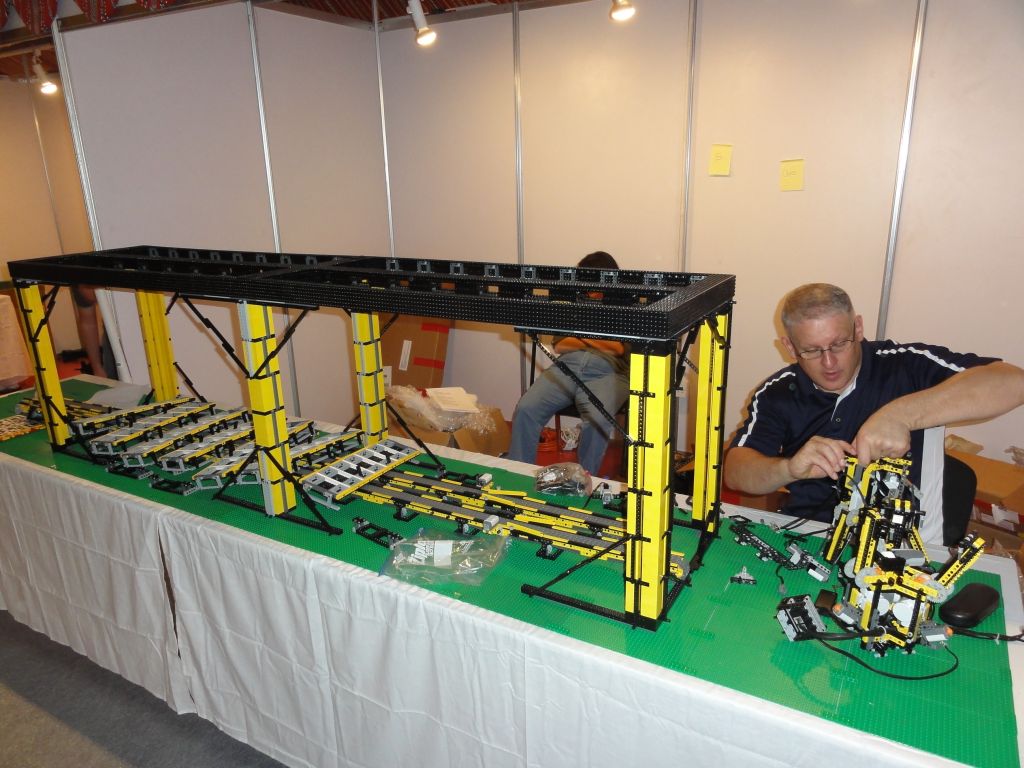
I was diligently working on a robot to take, but due to some technical difficulties I wasn’t able to take it. I am still working on it so I don’t have any videos, but I think you will like it. It’s similar in style in that it has tons of movements which require lots and lots of mathematical calculations. It’s those calculations which I wasn’t able to solve (and still to this day haven’t been able to completely debug.) But I am absolutely driven at this point to get them solved….I am soooooo close.
Michael Brandl, one of the other MCPs who attended the WRO has put together an outstanding web page showing all the information about the WRO, what we did, where we went, what we ate, when we went to bed and woke up…Ok, maybe a little bit of exaggeration. But it’s a great scrapbook that I will be showing off for years to come.
If you ever get the opportunity to attend something like this, do whatever you can do to get there. You will be blessed.
It was an incredible display of cooperation between people of many, many countries and cultures. I have never been part of something so diverse, so wide spread, so incredible. Every moment was an experience that I will forever treasure. Literally, one moment I would be speaking to someone from China, then Oman, then Egypt, then Brazil, then the Phillipines, then Syria, and on and on. We all had one big thing in common, which I share with you; the love of LEGO robotics, the thirst for learning and the excitement of being a part of something so big. Everyone was happy.
I got to take my big Four Lego Delta Robots setup, which was itself a feat. I had to break it down into about one hundred small parts and pack it into eight boxes. Then the shipping company, DHL broke it down into about 500 more pieces during shipping so I had to spend almost a full day fixing it. I got it to work and it actually worked the whole show without many problems. And a note to you about shipping robots, don’t expect that it won’t arrive in the same number of pieces that you packed it. It will be broken. ;)
I was diligently working on a robot to take, but due to some technical difficulties I wasn’t able to take it. I am still working on it so I don’t have any videos, but I think you will like it. It’s similar in style in that it has tons of movements which require lots and lots of mathematical calculations. It’s those calculations which I wasn’t able to solve (and still to this day haven’t been able to completely debug.) But I am absolutely driven at this point to get them solved….I am soooooo close.
Michael Brandl, one of the other MCPs who attended the WRO has put together an outstanding web page showing all the information about the WRO, what we did, where we went, what we ate, when we went to bed and woke up…Ok, maybe a little bit of exaggeration. But it’s a great scrapbook that I will be showing off for years to come.
If you ever get the opportunity to attend something like this, do whatever you can do to get there. You will be blessed.
Lego Loom
MAKE pointed out that sren2000 also has a really cool RCX controlled Loom. I am so impressed by this thing. It's got some awesome mechanical movements and robotic controls. It's just plain fun to watch.
Wednesday, December 21, 2011
Polar Graphing by sren2000
There's not much information about this plotter, like how it's controlled and what it looks like in real time, but it's VERY impressive how the lines are so smooth.
Sunday, December 18, 2011
Festo Automation
Here's a Festo station that has lots of really cool movements. I have absolutely no idea what it does except sort some little round pieces, but I know it will inspire a few of you out there. I love all the little movements.
Wednesday, December 14, 2011
LEGO Injection Molding.
Here's a short video of just one of many injection molding machines in the LEGO Billund factory. Not very glorious at this point, but the final product is simply awesome!!
Sunday, December 11, 2011
Subscribe to:
Posts (Atom)


